
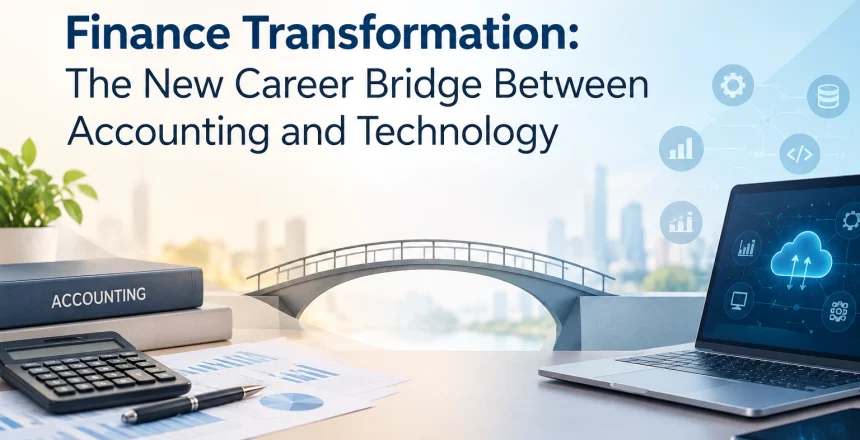
Finance teams used to exist to record transactions, close the books, and stay compliant. That job has not gone away, but it is no longer the whole story. Across India’s finance function, in corporates, banks, fintechs, and especially Global Capability Centres (GCCs), accountants are becoming technology-enabled business partners. They use automation, analytics, cloud platforms, and AI to help leaders make better decisions.
This shift has opened up a career track worth paying attention to: finance transformation.
What Finance Transformation Actually Means
At its core, finance transformation is about redesigning how finance operates so it becomes faster, more accurate, and more useful to the business. In practice, that could mean automating repetitive bookkeeping tasks, upgrading an ERP system, building real time dashboards instead of static spreadsheets, standardizing processes across countries, or using AI to sharpen forecasting and reporting.
Picture a finance team that used to spend a week each month pulling spreadsheets into a report. A transformed version of that team pipes data straight from the ERP into Power BI, automates the consolidation, and gives managers a live dashboard instead of a static PDF. The accountant has not been replaced. Their role has moved from manually producing numbers to designing, validating, and interpreting them.
Why This Is Growing in India
India’s finance professionals increasingly serve multinational employers and shared service hubs that need standardized, technology driven processes across geographies. A look at real job postings shows what these roles now demand. One finance manager listing from Bain, for example, asks for process standardization skills alongside Power BI, Power Query, Alteryx, Power Automate, generative AI, Anaplan, SAP Analytics Cloud, Oracle EPM, SQL, and Python.
That is the pattern across the industry. Employers are not hiring pure accountants or pure technologists. They want people who are comfortable with both.
The Roles Behind the Title
Finance transformation is not one job title. It is a career area that spans several roles, including Finance Transformation Analyst, FP&A Analyst, Finance Systems Analyst, ERP Finance Consultant, Finance Data Analyst, Business Finance Partner, Internal Controls and Automation Specialist, and Finance Transformation Manager. Each one blends accounting knowledge with a different technical or process specialty, from ERP configuration to SQL driven analytics to change management.
The Four Skill Areas That Matter
1. Accounting fundamentals
Financial statements, cost accounting, budgeting, internal controls, and a working knowledge of US GAAP, IFRS, or Ind AS.
2. Data and technology
A natural progression runs from advanced Excel and Power Query, to Power BI, ERP basics such as SAP, Oracle, or Workday, SQL, automation tools like Power Automate or Alteryx, and eventually basic Python and responsible use of generative AI.
3. Process improvement
Process mapping, root cause analysis, lean methods, robotic process automation, shared service models, and project management.
4. Business communication
The ability to explain a variance to a non finance manager, present a dashboard in plain language, and train users after a system rollout. Transformation projects rarely fail because the technology does not work. They fail because people do not adopt it.
Where Certifications Fit In
Two global credentials stand out for this path, and they serve different goals.
The US CMA, awarded by the Institute of Management Accountants, covers planning, budgeting, performance management, cost management, internal controls, technology and analytics, and business decision analysis. It is a natural fit for FP&A, business partnering, and strategic finance roles.
The US CPA now has three core exam sections: Auditing and Attestation, Financial Accounting and Reporting, and Regulation. Candidates also choose a discipline: Business Analysis and Reporting, Information Systems and Controls, or Tax Compliance and Planning. The Information Systems and Controls discipline speaks directly to transformation work involving systems, controls, and technology risk.
As a general rule, choose CMA first if you are heading toward FP&A, cost management, or business partnering. Choose CPA first if you are aiming at reporting, audit, controls, or US GAAP compliance. If your goal is transformation leadership, either path can work, as long as it is paired with real technology skills. No certification substitutes for knowing your way around Power BI or an ERP system.
A Practical First Year
Months 1 to 3
Sharpen Excel and Power Query, learn Power BI basics, study core processes such as procure to pay, order to cash, and record to report, and start certification prep.
Months 4 to 6
Build two dashboards from public company data, learn ERP fundamentals, document and redesign a sample process, and begin applying for entry level FP&A or finance systems roles.
Months 7 to 12
Continue studying for CMA or CPA, gain hands on experience in close, reporting, or controls work, pick up SQL or an automation tool, and rewrite your resume around measurable outcomes rather than duties. “Automated a monthly reporting process using Power Query and Power BI” says more than “prepared monthly MIS reports.”
Transform your future with Global Certifications
Finance transformation sits at the intersection of accounting expertise and technology enabled decision making. The strongest profile is not a certification alone. It is certification plus systems knowledge plus data analytics plus process improvement plus the communication skills to bring people along. That combination opens doors across FP&A, GCCs, controllership, ERP consulting, and strategic finance.
Sources
- Bain & Company — Finance Manager job listing
- Institute of Management Accountants — CMA Certification
- AICPA & CIMA — CPA Exam Toolkit