
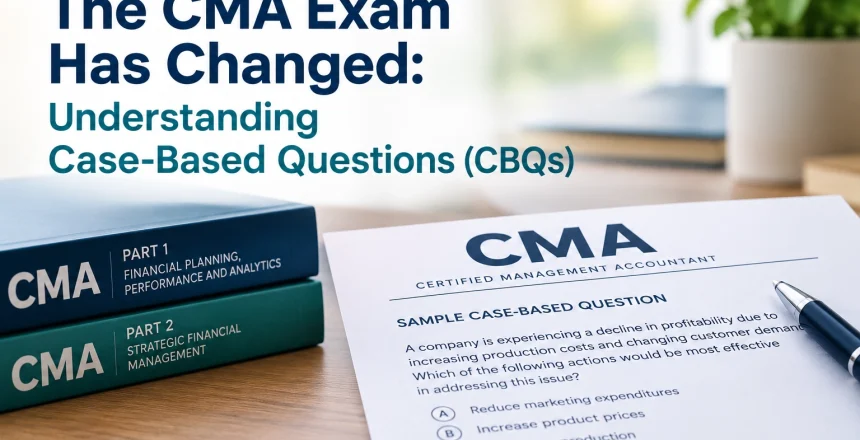
The US CMA examination has transitioned from the traditional essay format to Case-Based Questions (CBQs). At first glance, this may sound like a completely new examination. It isn’t.
The concepts being tested remain the same. What has changed is how those concepts are presented and how candidates are expected to demonstrate their understanding.
And that distinction matters.
If you’re preparing for the CMA exam, the most useful question isn’t simply, “What is a CBQ?” It is: “How should I change the way I prepare?”
So, What Exactly Are CMA Case-Based Questions?
A Case-Based Question starts with a short business situation. Instead of presenting every question independently, the exam places several related questions around the same case.
The case may include information about a company, its operations, financial decisions, performance, or a particular business problem. Supporting exhibits may provide calculations, financial information, tables, or other data.
The questions that follow can use different formats, including:
- Single-choice questions
- Select-from-a-list questions
- Fill-in-the-blank questions
- Numeric-entry questions
- Drag-and-drop questions
- Sequencing or classification questions
The important part is that the candidate isn’t simply recalling a definition. The information has to be interpreted and applied in the context of the case.
A Simple Example
Consider a company preparing its production budget.
The case provides:
- Expected sales
- Beginning inventory
- Desired ending inventory
- Production capacity
- Relevant cost information
The questions might then ask for the required production units, identify an appropriate budgeting approach, classify information, or select the statement that best explains the company’s decision.
The underlying topic is still budgeting.
The difference is that the concept is now embedded inside a business situation.
Has the CMA Syllabus Changed?
This is probably the first thing worth clarifying.
No content change is being introduced simply because of the move to CBQs from Essays.
The IMA‘s Content Specification Outline and Learning Outcome Statements remain the foundation of the examination.
So, topics such as budgeting, variance analysis, internal controls, performance management, financial reporting, cost management and the other concepts covered in the CMA curriculum continue to matter.
The change is primarily in the assessment format.
That means preparation shouldn’t start with throwing away existing study material and looking for an entirely new syllabus. It should start with learning how to apply the existing concepts in a case environment.
What Feels Different in CMA Case-Based Questions?
This is where preparation needs to become more deliberate.
1. The case has to be read before the question is solved
One of the easiest mistakes is to look at the numbers and immediately start calculating.
But the case may contain information that is relevant to one question and irrelevant to another.
A better approach is to first understand:
Who is the company? What is happening? What decision or problem is being presented? What information has actually been provided?
Only then should the calculation begin.
2. Application becomes more visible
Knowing a formula is one thing.
Knowing when to use it is another.
For example, memorising a variance formula doesn’t automatically mean the correct variance can be identified when the information is presented inside a business case.
CBQs therefore reward understanding over isolated memorisation.
3. The exhibits matter
A case may include tables, financial information or supporting data.
Not every number deserves equal attention.
The ability to separate relevant information from background information becomes an important exam skill.
4. The question format itself should not become a distraction
A candidate can understand the concept and still lose time simply because the question format feels unfamiliar.
That is why practising different CBQ formats is useful.
The objective isn’t to become good at clicking buttons. It is to make the format familiar enough that the attention stays on the accounting or finance problem itself.
A Mentor’s Perspective: Don’t Make CBQs Bigger Than They Are
One thing I would tell a CMA candidate preparing for the new format is this:
Don’t let the word “case” make the question sound more complicated than it is.
A case may contain more information than a traditional MCQ, but that doesn’t mean every piece of information needs to be used.
When practising, try asking:
Why has this information been given?
What is the question actually asking me to find?
Which information is relevant to this particular question?
That habit can make a significant difference.
The objective is not to read the case five times and then solve it. The objective is to understand the situation, identify what matters, and make the appropriate application.
Another Important Change: You Are No Longer Writing an Essay
The traditional essay section required candidates to communicate their answers in written form.
CBQs replace that with objectively answerable question formats.
That means the emphasis shifts away from constructing a written response and towards interpreting information, applying concepts and arriving at the correct answer.
For many candidates, particularly those who found the written component stressful, this may make the assessment feel more focused.
It also means that preparation should include more than simply reading theory.
The question becomes:
Can the concept be recognised when it appears in a business situation?
What Should Preparation Look Like Now?
A strong CBQ preparation strategy should have three layers.
First: understand the concept.
Before attempting a case, the underlying accounting or finance concept should be clear.
Second: practise application.
Take that concept and solve questions where the information is presented through a business situation.
Third: practise the format.
Work with different CBQ question types so that the mechanics of the exam don’t consume unnecessary time.
And there is one more habit worth developing:
Don’t just check whether the answer is right. Understand why it is right.
If an answer is wrong, identify whether the problem was the concept, the interpretation of the case, the calculation, or simply reading the question incorrectly.
That is where practice becomes useful—not just repetition.
How FINSPIRE Is Approaching the Transition
At FINSPIRE Academy, the focus isn’t simply on creating questions that look like CBQs.
The larger objective is to help candidates develop the thinking required to work through them.
That includes:
- Case-based practice
- Scenario and exhibit analysis
- Application-focused questions
- Different CBQ formats
- Timed practice
- Discussion of why an answer is correct and why the alternatives are not
Because ultimately, the goal isn’t to memorise how a CBQ looks.
It is to become comfortable thinking through one.
The CMA Exam Is Changing. Your Foundation Doesn’t Have To.
The move from essays to Case-Based Questions is an important change in the way the CMA examination is delivered.
But it doesn’t mean that everything learned so far has become irrelevant.
The accounting, finance and management concepts remain the foundation.
What needs to develop alongside that foundation is the ability to read a business situation, identify what matters, apply the right concept and arrive at a decision efficiently.
For a candidate preparing today, that is the real shift.
Not from studying concepts to studying CBQs.
But from knowing the concept to knowing how to use it.
For CMA candidates, the shift to Case-Based Questions isn’t about studying more – it’s about learning to think differently. Understanding the concept is still the foundation; knowing how to interpret a case, identify what matters, and apply that knowledge is what will set you apart. At FINSPIRE Academy, we help CMA aspirants make that transition with structured CBQ practice, application-focused learning, and the right guidance to approach the new exam format with confidence.
Learn more at www.finspireacademy.com