
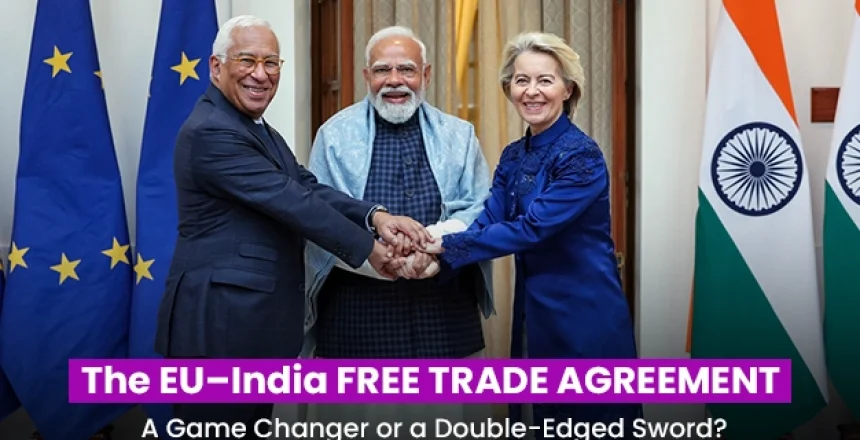
A Game Changer or a Double-Edged Sword?
The EU–India Free Trade Agreement has finally been sealed after nearly two decades of negotiations, marking what both sides call the “mother of all trade deals.” Concluded on 27 January 2026 at an India–EU summit in New Delhi, the agreement aims to liberalise trade and investment between the two economies through phased commitments covering goods, services, and regulatory cooperation. But for Indian businesses, the big question remains — is this a golden opportunity or a complex challenge dressed up in diplomatic fanfare?
The Scale of the Deal
To understand what is at stake, consider the sheer size of this agreement. Covering nearly two billion people and almost a quarter of global economic output, the deal marks the biggest bilateral trade pact either side has ever signed. The EU is India’s largest trading partner for goods, with bilateral goods trade reaching approximately $136.5 billion in financial year 2024–25. The deal promises to push that number significantly higher over the coming years.
The timing is also critical. India’s trade exposure remains heavily skewed toward the US, with a $45.8 billion goods surplus with the US in 2024, versus $25.8 billion with the EU — making the FTA a meaningful, if partial, cushion against punitive US tariff shocks.
What Indian Businesses Stand to Gain
The opportunities for Indian exporters are substantial across multiple sectors. India secured market access for more than 99% of Indian exports by trade value, with labor-intensive sectors such as textiles, apparel, leather, footwear, marine products, gems and jewelry, handicrafts, engineering goods and automobiles set to receive a decisive boost.
For India’s technology sector, the gains are equally compelling. IT services, chemicals, administrative services, food and beverages, and textiles are among the top expanding sectors for Indian exports to the EU under the FTA. The pharmaceutical industry is another standout — India is the world’s largest producer of generic medicines by volume, and tariff elimination combined with streamlined regulatory procedures will boost Indian pharmaceutical sales in Europe.
Beyond goods, the services dimension is arguably even more transformative. India’s services commitments under this FTA are the most ambitious it has ever undertaken, surpassing concessions granted to partners such as the United Kingdom and Australia. For IT firms and professionals, a comprehensive mobility framework means smoother movement of skilled talent into European markets.
The Challenges Indian Businesses Cannot Ignore
Despite the optimism, seasoned trade experts are urging caution. Several significant hurdles remain that could dilute the benefits for Indian industry, particularly smaller businesses.
The EU’s Carbon Border Adjustment Mechanism (CBAM) is perhaps the most pressing concern. Indian exports of steel, aluminium, cement, and fertilisers are affected by this carbon tax, and the development and implementation of an Indian emissions trading system will likely take many years. Notably, the US secured an exemption in its own trade deal — a concession India has not been able to match.
Compliance is another major barrier. Many Indian MSMEs lack the compliance infrastructure to meet European standards for product quality, environmental performance, and documentation, meaning gains could remain concentrated among large corporates with existing export experience, rather than trickling down to smaller firms.
Intellectual property rights provisions also raise concerns, especially for India’s generic pharmaceutical sector, which has long relied on a more flexible IP framework to supply affordable medicines to the world.
The Strategic Opportunity
Despite the cautions, the bigger picture is undeniably positive for India’s long-term economic positioning. Combined with India’s large workforce and industrial incentives such as Production-Linked Incentive schemes, the FTA reinforces India’s rising position as a preferred base for manufacturing, R&D, and services exports — strengthening its role as a China-plus-one destination.
Europe accounted for $70 billion of FDI inflows into India in 2023–24, a figure that enhanced investment protection and regulatory certainty under the FTA is expected to grow significantly.
Double-Edged Sword
The EU–India FTA is neither a guaranteed windfall nor a threat — it is a strategic inflection point that rewards the prepared. Large exporters with established compliance systems stand to benefit immediately. For MSMEs, the gains will depend heavily on government support, capacity building, and phased tariff liberalisation. India must invest in equipping its smaller businesses to meet European standards, or risk watching the benefits of this historic deal accrue only to those already at the top.
The deal is signed. Now comes the harder part — making it work for every level of Indian business.